


Leading people in different generations is like global warming. Everyone feels it’s happening, but most people don’t know what to do about it.
Luckily for you, I am going to share some insights to help you improve a team’s performance regardless of the age of team members.
Who am I, and why should you care? I’m John Eades, the CEO of LearnLoft, a leadership development company that helps improve organizational performance through leadership. We have spent the last ten years studying, obsessing, and distributing ideas around leadership to help you be a more effective leader.
However, most people are surprised to hear that I got into the leadership development space because I was one of the 60% of managers who failed within the first 18 months. Instead of being okay with failure, I decided to do everything I could to ensure that others wouldn’t be met with the same temporary fate I was.
At the beginning of every Accelerate Leadership Workshop, I ask participants one question: “What is one thing you are challenged with as a leader that you want to improve as a part of the program?”
While there are all kinds of answers, like having difficult conversations, being an effective communicator, stopping negatively, and coaching others, the most common one is…you guessed it, “overcoming generational issues.”
Since thousands of leaders struggle with this, I will assume you do as well. The five-part pyramid starts at the bottom and works its way up.

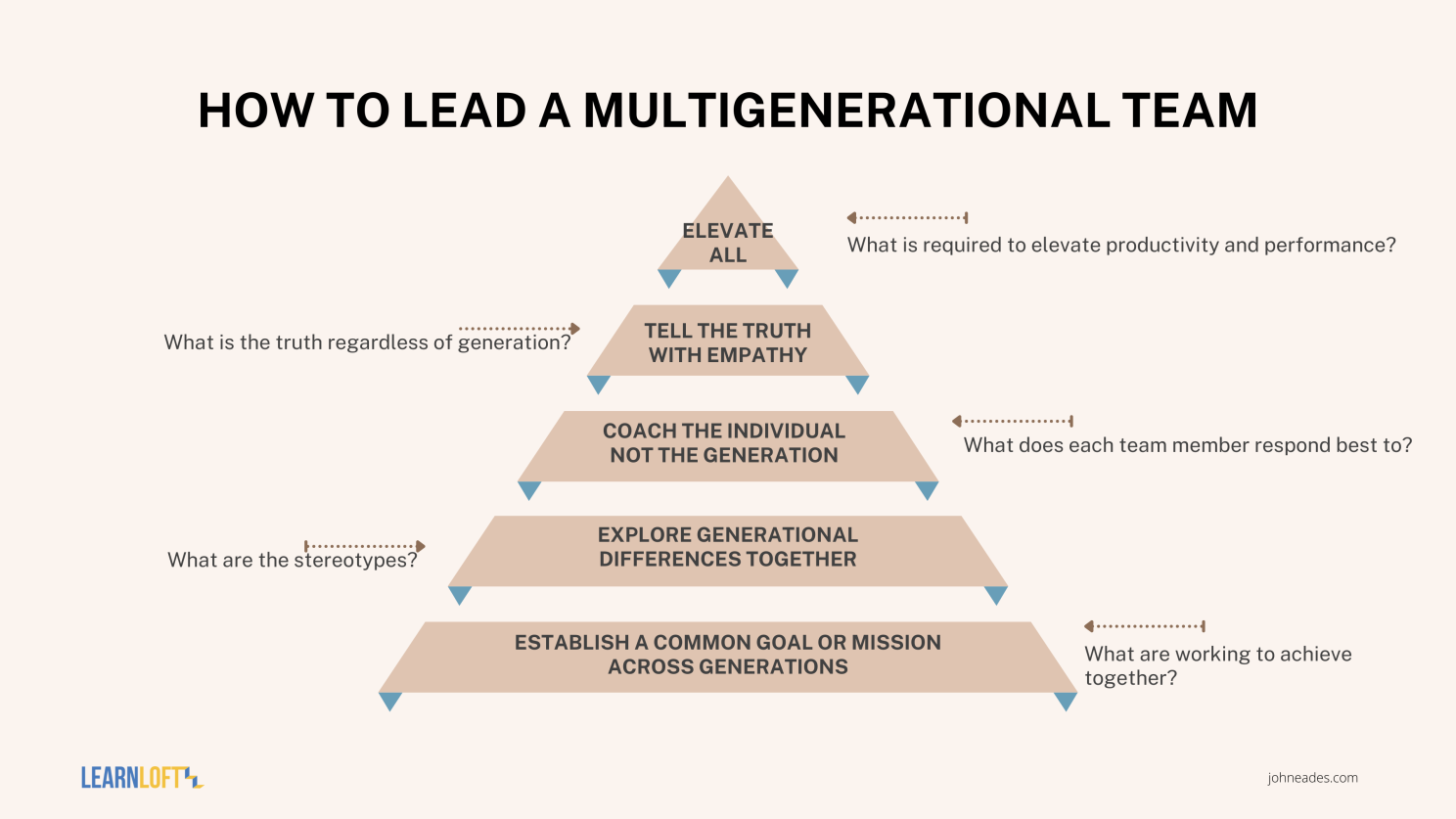
How to Successfully Lead a Multigenerational Team
Leading multigenerational teams requires understanding five distinct elements, but each is somewhat related. After you grasp all five parts, they blend together like art instead of science.
Establish a Common Goal or Mission Across Generations
- Team Goal or Mission –A team is defined as a group of people working together to achieve a common goal. People bonding together to achieve more together than they can on their own. So the foundation of leading a multigenerational team is establishing a common goal or mission that everyone, regardless of generation, cares about achieving. A question you must answer, what is the group looking to achieve, and by when? Remember the African Proverb, “If you want to go fast, go alone; if you want to go far, go together.”
- Know Internal Motivations –Now, it’s time to focus on internal motivations. Each person can be motivated by a variety of factors. It’s more likely that Boomers are motivated by things like title, status, results, and money. Generation X tends to be motivated by job security, freedom, and money. Millennials often are motivated by purpose, opportunities to make an impact, and recognition. Gen Z is typically motivated by praise, learning opportunities, and stability. While these are stereotypes, all generations now care about flexibility because of the pandemic.
Explore Generational Differences Together
When leading a multigenerational workforce, it’s vital to recognize and explore the different generations and understand their typical characteristics and motivations (which we just covered). Here is a quick chart of some key generational differences:

Exploring these generational distinctions is a critical phase to leading the team effectively. Being on the same page about some of the natural differences provides the groundwork for building mutual respect and collaboration versus complaining about each other behind people’s backs.
Coach the Individual, Not the Generation
Leadership is ultimately a one-on-one game. Yes, if you are the President of a country or working to influence thousands of people at once, this doesn’t apply. However, most managers or supervisors are responsible for leading groups of people between 3 and 20, which means they must have a relationship built on trust with each person to be effective.
Regardless of skill level or tenure, every professional can use coaching. However, the temptation of coaching team members in different generations is to coach them all the same. Reject this temptation. To act as an effective coach today requires you to know a powerful leadership principle: